
Curators of Human Civilization’s Journey
TRAVEL BEYOND DESTINATIONS


Madhya Pradesh Educational Learning Journeys
Experiential Expeditions Through Heritage, Wildlife, Geology, Culture & Conservation
Madhya Pradesh offers some of India's most immersive educational travel opportunities. From UNESCO World Heritage monuments and medieval kingdoms to tiger conservation landscapes, diamond exploration fields, tribal crafts, and biodiversity-rich forests, every destination becomes a living classroom. These carefully curated educational journeys are designed for schools, colleges, universities, study groups, and experiential learners seeking meaningful engagement beyond traditional sightseeing.
Route 1
The Bundelkhand Heritage & Conservation Learning Corridor
Delhi → Agra → Gwalior → Orchha → Khajuraho → Panna
A unique educational learning journey connecting Delhi, Agra, Gwalior, Orchha, Khajuraho and Panna through UNESCO heritage, architecture, geology, diamond exploration, wildlife conservation, traditional crafts and community-based learning experiences.

This educational travel poster showcases the Bundelkhand Heritage & Conservation Learning Corridor, a specially designed experiential learning journey by Christone Holidays. The route connects Delhi, Agra, Gwalior, Orchha, Khajuraho and Panna, offering students and educational groups immersive opportunities to study history, architecture, UNESCO heritage, geology, diamond exploration, tiger conservation, biodiversity, traditional block printing, regional cuisine and sustainable tourism. The journey transforms iconic destinations into living classrooms where learning happens through direct experience, community engagement and interaction with nature and culture.
Learning Themes
-
Indian History & Heritage
-
Architecture & UNESCO Studies
-
Medieval Kingdoms
-
Temple Engineering
-
Geology & Diamond Exploration
-
Tribal Livelihoods
-
Traditional Crafts
-
Wildlife Conservation
-
Sustainable Tourism
-
Biodiversity Studies
This journey begins in Delhi and travels through some of North and Central India's most important cultural landscapes before culminating in the conservation and educational experiences of Panna.
Signature Experiences
-
Heritage interpretation in Delhi and Agra
-
Fort and kingdom studies in Gwalior
-
Medieval town planning in Orchha
-
Temple architecture workshops in Khajuraho
-
Diamond exploration field learning in Panna
-
Tiger Block Printing workshops
-
Bundelkhand culinary experiences
-
Nature and birding studies
-
Panna Tiger Reserve conservation safari
-
Community-based tourism learning
Route 2
The Central India Wildlife, Geology & Heritage Learning Corridor
Jabalpur → Panna → Khajuraho


An immersive educational learning journey through Jabalpur, Panna and Khajuraho featuring Marble Rocks geology studies, Narmada River ecosystems, diamond exploration, wildlife conservation, biodiversity research and UNESCO heritage learning experiences by Christone Holidays.
Learning Themes
-
Geology & Earth Sciences
-
River Ecosystems
-
Wildlife Conservation
-
Biodiversity Studies
-
Diamond Formation & Mining History
-
UNESCO Heritage
-
Sustainable Tourism
-
Community Engagement
Key Learning Destinations
Jabalpur
Gateway to Central India's geological wonders.
Experiences
-
Marble Rocks interpretation
-
Narmada River ecosystem studies
-
Dhuandhar Falls geological observation
-
Rock formation and erosion studies
-
River conservation awareness
Panna
India's unique blend of wildlife conservation and diamond heritage.
Experiences
-
Panna Tiger Reserve educational safari
-
Diamond exploration activities
-
Nature walks and biodiversity surveys
-
Tiger Block Printing workshop
-
Bundelkhand culinary immersion
-
House of GK experiential homestay
-
Community interaction programmes
-
Birding and ecological studies
Khajuraho
A UNESCO World Heritage classroom.
Experiences
-
Temple architecture studies
-
Stone carving interpretation
-
Art and symbolism workshops
-
Heritage conservation awareness
-
Cultural history exploration
Route 1
The Bundelkhand Heritage & Conservation Learning Corridor
(Delhi → Agra ) → Gwalior → Orchha → Khajuraho → Panna
Available Access Gateways
-
Delhi International Gateway
-
Agra Heritage Gateway
-
Gwalior Airport Gateway
Delhi – International Gateway to the Learning Corridor
Delhi serves as the starting point for many international and domestic educational groups. Before entering Madhya Pradesh, students gain introductory exposure to India's historical evolution, urban development, governance, and cultural diversity.
Educational Themes
-
Evolution of Indian Civilization
-
Urban Planning
-
Heritage Conservation
-
Cultural Diversity
👉 Explore Delhi Educational Experiences →
Discover heritage monuments, museums, governance institutions, cultural districts, and learning opportunities in India's capital.
Agra – Mughal Heritage Gateway
Agra introduces students to one of the world's most celebrated architectural traditions and provides context for the evolution of Indian art, engineering, and cultural heritage.
Educational Themes
-
Mughal Architecture
-
Monument Conservation
-
Tourism Management
-
Cultural Heritage Studies
👉 Explore Agra Heritage Experiences →
Experience Mughal architecture, monument conservation, cultural heritage, and the world-famous Taj Mahal before continuing into Madhya Pradesh.
➜ Explore Agra Educational Journeys
👉 Begin the Bundelkhand Learning Corridor from Gwalior
The Bundelkhand Heritage, Architecture & Conservation Learning Corridor
Gwalior • Orchha • Khajuraho • Panna
Learning Beyond Classrooms in the Heart of India
Bundelkhand is one of India's most fascinating yet underexplored educational landscapes. Stretching across the northern regions of Madhya Pradesh, this historic corridor offers an extraordinary blend of medieval kingdoms, UNESCO World Heritage monuments, living cultural traditions, geological wonders, wildlife conservation initiatives, and community-based learning experiences.
Designed for schools, colleges, universities, educational institutions, nature clubs, architecture students, history enthusiasts, and experiential learners, the Bundelkhand Heritage, Architecture & Conservation Learning Corridor transforms every destination into a living classroom.
Rather than simply visiting monuments and attractions, students engage directly with history, engineering, art, biodiversity, geology, conservation, and local communities through immersive experiences that encourage observation, participation, and discovery.
Why Bundelkhand?
Bundelkhand represents a remarkable convergence of learning opportunities rarely found within a single educational journey.
Students can explore:
-
Medieval fortifications and defence engineering.
-
River-based settlements and sustainable urban planning.
-
UNESCO World Heritage architecture.
-
Ancient temple construction techniques.
-
Geological processes and diamond formation.
-
Tiger conservation and biodiversity management.
-
Traditional crafts and artisan livelihoods.
-
Rural sustainability and community tourism.
-
Regional cuisine and cultural heritage.
-
Environmental conservation and responsible tourism.
Every stage of the corridor introduces a new dimension of learning while remaining connected through the shared history and cultural identity of Bundelkhand.
Gwalior – Learning Through Forts, Kingdoms & Engineering
Perched atop a sandstone hill, Gwalior has witnessed centuries of dynastic rule, military innovation, and cultural development. The city provides one of India's finest outdoor classrooms for understanding medieval governance, defence systems, architecture, and urban planning.
Educational Themes
-
Medieval Indian History.
-
Fort Architecture.
-
Military Engineering.
-
Water Harvesting Systems.
-
Urban Development.
-
Cultural Heritage Conservation.
Experiential Learning Opportunities
Students explore how massive fortifications were designed to withstand invasions, how water was stored and distributed within fortified settlements, and how strategic geography influenced the growth of kingdoms.
Through guided interpretation and observation exercises, learners develop a deeper understanding of the relationship between geography, defence, governance, and society.
Medieval Indian History
Gwalior allows students to trace the evolution of Indian kingdoms through centuries of political change, cultural exchange, and military power.
Places to Explore
Gwalior Fort
The city's most iconic landmark and one of India's greatest hill forts.
Students learn about:
-
The Tomar Dynasty.
-
Mughal influence.
-
Maratha rule.
-
Scindia legacy.
-
Political transitions through history.
-
Jai Vilas Palace Museum
A remarkable example of royal heritage and governance.
Students explore:
-
Royal administration.
-
Lifestyle of ruling families.
-
Colonial-era influences.
-
Historical artefacts and archives.
Gujari Mahal Archaeological Museum
A treasure house of sculptures and archaeological remains.
Students gain insights into:
-
Historical art forms.
-
Ancient inscriptions.
-
Cultural development.
-
Evolution of religious practices.
Fort Architecture
Gwalior Fort serves as a masterclass in military architecture and defensive planning.
Places to Explore
Gwalior Fort Complex
Students observe:
-
Massive defensive walls.
-
Strategic gateways.
-
Elevated fortifications.
-
Watch points and observation areas.
-
Natural topographical advantages.
Man Mandir Palace
Students study:
-
Palace planning.
-
Decorative architecture.
-
Structural design.
-
Artistic integration within defensive complexes.
Karan Mahal
Students explore:
-
Royal architecture.
-
Construction techniques.
-
Architectural evolution within fortified settlements.
Gwalior – Learning Through Forts, Kingdoms & Engineering
The Gateway to the Bundelkhand Heritage, Architecture & Conservation Learning Corridor
Gwalior serves as the gateway to the Bundelkhand Learning Corridor, where students explore medieval kingdoms, military engineering, fort architecture, ancient water systems, urban planning, and heritage conservation through immersive educational experiences.

This educational travel poster highlights Gwalior as the first stage of the Bundelkhand Heritage, Architecture & Conservation Learning Corridor. The image showcases the magnificent Gwalior Fort, ancient water reservoirs, royal architecture, and students participating in hands-on learning activities. Educational themes include Medieval Indian History, Fort Architecture, Military Engineering, Water Harvesting Systems, Urban Development, and Cultural Heritage Conservation. Designed for schools, colleges, universities, and experiential learning groups, Gwalior provides a unique opportunity to study India's historical, architectural, and engineering achievements through direct observation and exploration.
Military Engineering
The fort's location and design demonstrate sophisticated engineering solutions developed long before modern technology.
Places to Explore
Fort Ramparts and Defensive Walls
Students examine:
-
Strategic positioning.
-
Defence systems.
-
Battlefield advantages.
-
Fortification techniques.
Hathi Pol & Badalgarh Gate
Students learn:
-
Controlled access systems.
-
Defence-oriented gateway design.
-
Security planning.
-
Military movement management.
Strategic Hilltop Locations
Students analyse:
-
Natural defence advantages.
-
Observation and surveillance.
-
Geographic planning in warfare.
Water Harvesting Systems
One of Gwalior's greatest educational strengths lies in its historical water management systems.
Places to Explore
Suraj Kund
One of Gwalior's oldest reservoirs.
Students study:
-
Rainwater collection.
-
Ancient water storage.
-
Community water management.
-
Sustainable resource use.
Historic Water Tanks Within the Fort
Students explore:
-
Water security strategies.
-
Storage engineering.
-
Resource management during sieges.
Stepwells and Reservoir Structures
Students learn:
-
Traditional hydraulic engineering.
-
Water conservation techniques.
-
Adaptation to seasonal rainfall.
Urban Development
Gwalior provides an excellent example of how historical cities evolved around geography, defence, commerce, and culture.
Places to Explore
Gwalior Old City
Students observe:
-
Traditional settlement patterns.
-
Market development.
-
Community organisation.
-
Urban expansion.
Maharaj Bada
A vibrant city centre reflecting historical and modern urban growth.
Students study:
-
Public spaces.
-
Commercial activity.
-
Transportation networks.
-
Civic planning.
Jai Vilas Palace Precinct
Students understand:
-
Administrative planning.
-
Urban hierarchy.
-
Relationship between governance and city development.
Cultural Heritage Conservation
Preserving historical monuments requires continuous effort, expertise, and community involvement.
Places to Explore
Gwalior Fort
Students learn:
-
Monument conservation.
-
Structural preservation.
-
Tourism management.
-
Visitor impact on heritage sites.
Gujari Mahal Museum
Students explore:
-
Artefact conservation.
-
Museum management.
-
Heritage interpretation.
Sas Bahu Temples
Students observe:
-
Stone preservation techniques.
-
Challenges of conserving ancient structures.
-
Role of archaeology in heritage protection.
Teli Ka Mandir
Students study:
-
Architectural conservation.
-
Historical significance.
-
Long-term preservation strategies.
Signature Educational Experiences in Gwalior
Heritage Documentation Exercise
Students record architectural features, historical observations, and conservation challenges.
Fort Mapping Activity
Participants analyse the fort's layout and understand strategic planning principles.
Water Conservation Study
Students compare ancient water systems with modern sustainability practices.
Architectural Sketching Session
Learners document monuments through observation and drawing.
Museum Interpretation Workshop
Students examine artefacts and learn how museums preserve and present history.
Heritage Conservation Discussion
Interactive sessions on protecting cultural heritage for future generations.
Orchha
Learning Through River Civilisation, Heritage & Sustainable Settlements
Orchha – Learning Through River Civilisation & Living Heritage
Nestled along the tranquil banks of the Betwa River, Orchha is a remarkable living classroom where history, architecture, culture, and nature come together to tell the story of a thriving river civilisation. Once the capital of the Bundela rulers, this historic town preserves an extraordinary collection of palaces, temples, cenotaphs, and cultural landscapes that offer valuable insights into how settlements evolved around water, trade, governance, and faith.
Unlike many heritage destinations that exist only as monuments of the past, Orchha remains a living heritage town where centuries-old traditions continue alongside daily life. Its riverside setting, royal architecture, sacred spaces, and traditional communities provide students with a unique opportunity to explore the relationship between natural resources and human development.
As students walk through the grand courtyards of Jahangir Mahal, observe the architectural brilliance of ancient temples, and stand beside the iconic cenotaphs reflected in the waters of the Betwa River, they begin to understand how geography shaped kingdoms, influenced urban planning, and supported cultural growth. The town becomes an open-air laboratory for studying river-based settlements, historical urban planning, Bundela heritage, temple architecture, and heritage conservation.
Through heritage walks, architectural documentation, river ecosystem observations, cultural interpretation exercises, photography, and sketching activities, learners engage directly with the landscape rather than simply observing it. Every monument, riverbank, and historic street reveals a lesson about sustainable settlement development, cultural identity, and the enduring connection between people and place.
Orchha is more than a destination on the Bundelkhand Learning Corridor—it is a journey into the heart of a civilisation shaped by rivers, enriched by culture, and preserved through generations, offering students an immersive experience where history continues to live, breathe, and inspire.
Orchha – Learning Through River Civilisation & Living Heritage
Exploring the Relationship Between Rivers, Settlements, Architecture & Culture
Orchha offers a unique educational landscape where students explore the relationship between rivers, settlements, architecture and heritage conservation through immersive learning experiences along the Betwa River and the historic Bundela capital.

This educational travel image showcases Orchha as a key stage of the Bundelkhand Heritage, Architecture & Conservation Learning Corridor. Featuring the magnificent Jahangir Mahal, the iconic cenotaphs along the Betwa River, historic temples and traditional Bundelkhand landscapes, the image highlights experiential learning opportunities focused on river-based settlements, historical urban planning, Bundela heritage, temple architecture, cultural landscapes and heritage conservation. Students engage in architectural documentation, heritage interpretation, river ecosystem observation and cultural studies, transforming Orchha into a living classroom that connects history, environment and sustainable tourism.
Orchha Educational Themes
River-Based Settlements
Students learn:
-
Why cities developed along rivers.
-
Importance of the Betwa River.
-
Water and settlement relationships.
-
Trade and transportation routes.
-
Agricultural development.
Sites
-
Betwa River
-
Kanchana Ghat
-
Riverfront Cenotaphs
Betwa River, Kanchana Ghat & Riverfront Cenotaphs | Orchha Educational Learning Experience

This educational travel image showcases three of Orchha's most significant learning sites: the Betwa River, Kanchana Ghat and the historic Riverfront Cenotaphs (Chhatris). The image highlights experiential learning activities including heritage documentation, river ecosystem observation, architectural sketching, cultural interpretation and historical studies. Students gain insights into how rivers influenced settlement development, trade, governance, architecture and cultural identity within the Bundela Kingdom. The scene demonstrates Orchha's role as a living classroom where history, heritage, ecology and sustainable tourism come together.
Betwa River, Kanchana Ghat & Riverfront Cenotaphs
Exploring How Rivers Shaped Settlements, Culture & Heritage in Orchha
Historical Urban Planning
Students explore:
-
Planned royal cities.
-
Public spaces.
-
Market development.
-
Defensive planning.
-
Civic infrastructure.
Sites
-
Orchha Town
-
Raja Mahal Complex
-
Historic Streets
Bundela Heritage
Students discover:
-
Rise of the Bundela Kingdom.
-
Regional governance.
-
Architecture and culture.
-
Political history.
Sites
-
Raja Mahal
-
Jahangir Mahal
-
Royal Complex

This educational travel image highlights Orchha's remarkable urban planning and Bundela heritage through key landmarks including Orchha Town, Raja Mahal Complex, Historic Streets, Jahangir Mahal and the Royal Complex. Students engage in architectural documentation, heritage interpretation, urban planning observation, cultural studies and experiential learning activities. The image demonstrates how the Bundela rulers developed a strategically planned capital that integrated governance, defence, religion, commerce and community life. Through direct observation of palaces, courtyards, streets and public spaces, learners gain valuable insights into historical city planning, royal architecture and the cultural evolution of Bundelkhand.
Historical Urban Planning & Bundela Heritage
Understanding How the Bundela Rulers Shaped a Planned Royal Capital Along the Betwa River
What can students learn from Orchha's historical urban planning and Bundela heritage?
This image supports the educational narrative by showing how Orchha was not just a royal city, but a carefully designed urban centre where architecture, governance, defence, culture and community life were seamlessly integrated. It forms the perfect bridge between the River Civilisation section and the upcoming Temple Architecture & Heritage Conservation section.
Temple Architecture
Students learn:
-
Temple design principles.
-
Symbolism.
-
Stone craftsmanship.
-
Religious architecture.
Sites
-
Chaturbhuj Temple
-
Ram Raja Temple
-
Lakshmi Narayan Temple
Heritage Conservation
Students study:
-
Preservation challenges.
-
Active religious sites.
-
Living heritage.
-
Tourism management.
Sites
-
Entire Orchha Heritage Zone
Orchha Temple Architecture & Heritage Conservation | Educational Learning Experience
Explore the architectural brilliance of Orchha's temples through immersive educational experiences focused on structural design, stone craftsmanship, cultural heritage and monument conservation.

This educational travel image showcases Orchha's most significant architectural landmarks, including the Chaturbhuj Temple, Ram Raja Temple and Lakshmi Narayan Temple. Students participate in architectural documentation, heritage sketching, cultural interpretation and conservation studies while exploring the engineering principles, artistic traditions and spiritual significance of Bundela-era temple construction. The image highlights how Orchha serves as a living classroom for understanding temple architecture, structural design, stone craftsmanship, monument preservation and sustainable heritage management.
Temple Architecture & Heritage Conservation
Exploring the Engineering, Artistry and Preservation of Orchha's Sacred Monuments
What can students learn from Orchha's temple architecture and heritage conservation?
This image forms the final educational module of Orchha, showing how architecture, spirituality, engineering and conservation come together to preserve the cultural legacy of the Bundela Kingdom for future generations. It also creates a natural transition into Khajuraho, where students encounter one of the world's finest examples of temple architecture and UNESCO heritage conservation.
JHANSI – Learning Through Leadership, Resistance & Military History
The Legacy of Rani Lakshmibai and India's First War of Independence
Located at the crossroads of Bundelkhand, Jhansi occupies a special place in Indian history. While many visitors know Jhansi through the legendary story of Rani Lakshmibai, the city also serves as an important classroom for understanding military architecture, colonial history, leadership, governance, and India's struggle for freedom.
For students, Jhansi offers an opportunity to move beyond textbook history and experience the landscapes where one of India's most celebrated freedom fighters made her stand against British rule during the Revolt of 1857.
The city combines powerful stories of courage and resilience with impressive examples of fort engineering and strategic defence planning, making it an ideal educational stop within the Bundelkhand Learning Corridor.
Jhansi Fort – Leadership, Resistance & Military History | Educational Learning Experience
Jhansi Fort offers students an immersive opportunity to explore military engineering, leadership, strategic planning, and India's First War of Independence through one of Bundelkhand's most iconic historical landmarks.
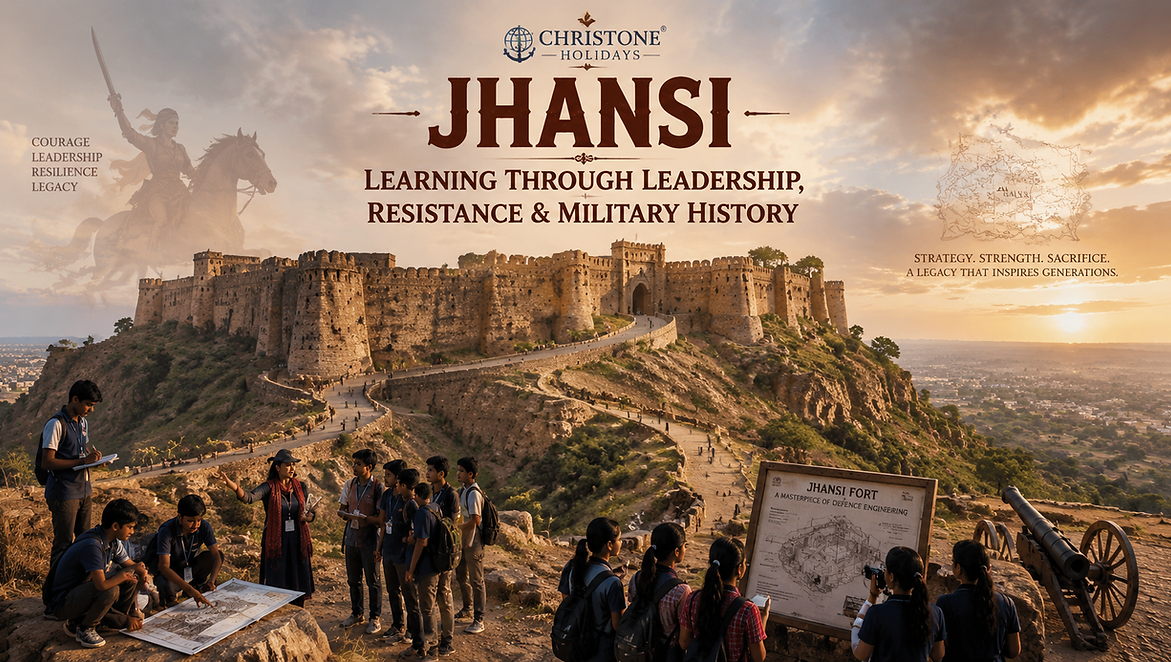
This educational heritage image showcases the historic Jhansi Fort, one of the most significant landmarks associated with the legacy of Rani Lakshmibai and the Revolt of 1857. Rising prominently above the Bundelkhand landscape, the fort serves as a living classroom where students can study military architecture, defensive engineering, strategic geography, leadership under crisis, and India's struggle for independence. As part of the Christone Holidays Bundelkhand Learning Corridor, Jhansi introduces learners to the intersection of history, resilience, governance, and heritage conservation while providing meaningful insights into one of India's most inspiring chapters.
What Can Students Learn in Jhansi?
Leadership & Decision-Making During Crisis
The story of Rani Lakshmibai provides valuable lessons in leadership, courage, responsibility, and resilience.
Students Explore
-
Leadership under pressure
-
Strategic decision-making
-
Crisis management
-
Women in leadership
-
Historical role models
Rani Lakshmibai Rani Lakshmibai (1828–1858), also known as the Queen of Jhansi, was an Indian monarch and a leading figure of the Indian Rebellion of 1857. Celebrated as a symbol of resistance to British colonial rule, she became a national icon for courage and patriotism in India’s independence narrative. Her defiance against the British East India Company made her one of the most enduring heroines in Indian history. Key facts Born: November 19, 1828, Varanasi, India Birth name: Manikarnika Tambe Died: June 17/18, 1858, near Gwalior, India Reign: Queen of Jhansi (1843–1858) Known for: Leadership in the Indian Rebellion of 1857 Early Life and Education Manikarnika Tambe, affectionately called “Manu,” was born into a Marathi Brahmin family. Her father, Moropant Tambe, served in the court of Baji Rao II, where she was trained in riding, fencing, and archery—unusual pursuits for women of her time. Raised in Bithoor, she grew up alongside Nana Sahib and Tantia Tope, who would later become key leaders in the 1857 uprising. Marriage and the Doctrine of Lapse In 1842 she married Gangadhar Rao Newalkar and assumed the name Lakshmibai. After their infant son’s death, the couple adopted a relative, Damodar Rao. Following the Maharaja’s death in 1853, Governor-General Lord Dalhousie invoked the “Doctrine of Lapse,” rejecting her adopted heir and annexing Jhansi. Lakshmibai’s appeal to London failed, leading her to famously declare, “Meri Jhansi nahi dungi” (“I will not give up my Jhansi”). The Rebellion of 1857 When the Indian Rebellion erupted, Lakshmibai took charge of Jhansi’s defense. She organized local forces—including women soldiers—and repelled attacks from neighboring princes before confronting the British army under General Hugh Rose. After weeks of siege, she escaped the fort on horseback with her son tied to her back, regrouped with Tantia Tope, and later fought fiercely at Gwalior. Death and Legacy Lakshmibai was mortally wounded in battle near Kotah-ki-Serai, Gwalior, in June 1858. To prevent British capture, her body was cremated by loyal followers. Remembered as “India’s Joan of Arc,” she became a lasting symbol of women’s valor and nationalist resistance. Poets such as Subhadra Kumari Chauhan immortalized her in verse—“Khoob ladi mardani, woh toh Jhansi wali Rani thi”—enshrining her in India’s collective memory.
India's First War of Independence (1857)
Jhansi played a crucial role during the Revolt of 1857, one of the most significant events in Indian history.
Learning Outcomes
-
Causes of the uprising
-
Colonial administration
-
Resistance movements
-
National identity formation
-
Historical interpretation
Military Architecture & Fort Engineering
The imposing Jhansi Fort demonstrates how medieval forts were designed for defence, surveillance, and long-term survival.
Students Learn
-
Fort construction techniques
-
Defensive architecture
-
Strategic positioning
-
Observation systems
-
Military planning
Jhansi Fort Jhansi Fort is a 17th-century hilltop fortress located in Jhansi, Uttar Pradesh, India. A key stronghold of the Bundelkhand region, it gained historical prominence during the 1857 Indian Rebellion for its association with Rani Lakshmibai, the Queen of Jhansi, who led a valiant defense against British forces. Key facts Location: Jhansi, Uttar Pradesh, India Built by: Raja Bir Singh Deo (early 1600s) Architectural style: North Indian military fortification Area: Approx. 15 acres Notable event: Siege of Jhansi, 1858 Historical background Constructed by Raja Bir Singh Deo of Orchha between 1613 and 1618, Jhansi Fort was designed to guard the strategic trade routes passing through Bundelkhand. The fort’s elevated position on Bangira Hill offered natural defenses and sweeping views of the surrounding plains. Over centuries, it served as a military bastion for successive regional powers before coming under British control in the 19th century. Architecture and layout The fort comprises thick granite walls, 10 massive gates, and several bastions, each named after local deities or nearby landmarks. Key structures inside include the Rani Mahal (Queen’s Palace), temples dedicated to Lord Shiva and Lord Ganesha, and military stables. The architectural blend of Bundela and Mughal influences reflects the political dynamics of the period. Role in the 1857 Rebellion During the Indian Rebellion of 1857, Rani Lakshmibai transformed Jhansi Fort into a rallying center for resistance. Her leadership during the siege by British forces in 1858 made the site a symbol of Indian valor and defiance. The fort remains closely tied to her legacy and is a major site of national heritage. Tourism and preservation Now managed by the Archaeological Survey of India, Jhansi Fort is open to visitors year-round. It hosts the annual Jhansi Mahotsav, celebrating local history and culture through performances, exhibitions, and reenactments. Restoration efforts continue to maintain its structural integrity and historical significance.
Strategic Geography & Defence Planning
The fort occupies an elevated rocky hill, offering commanding views of the surrounding landscape.
Educational Topics
-
Site selection
-
Natural defences
-
Strategic geography
-
Terrain analysis
-
Defensive advantages
Heritage Conservation
Students also gain insights into how historic monuments are preserved and interpreted for future generations.
Learning Areas
-
Heritage management
-
Conservation practices
-
Cultural preservation
-
Responsible tourism
-
Monument protection
Key Learning Sites
Jhansi Fort
The primary educational site for studying military architecture, leadership history, and the events of 1857.
Rani Mahal
Students explore royal life, architecture, cultural heritage, and historical interpretation.
Government Museum Jhansi
Provides valuable context on Bundelkhand history, archaeology, and the freedom movement.
Signature Educational Experiences
Leadership & History Walk
Students trace the life and legacy of Rani Lakshmibai through key historical locations.
Fort Engineering Study
Observe defensive walls, bastions, gateways, and strategic viewpoints.
Freedom Movement Interpretation Session
Understanding the historical significance of the Revolt of 1857.
Heritage Documentation Exercise
Students record architectural features and historical observations.
Educational Takeaway
Jhansi transforms history from a classroom subject into a lived experience. Through the story of Rani Lakshmibai, the engineering of Jhansi Fort, and the city's role in the freedom movement, students gain a deeper understanding of leadership, resilience, military strategy, and India's journey toward independence.
Khajuraho – Learning Through UNESCO Heritage, Temple Engineering & Artistic Excellence
Khajuraho - A celebration of love and life…
Khajuraho – Where Stone Becomes Story
Recognised as a UNESCO World Heritage Site, Khajuraho represents one of humanity's finest achievements in architecture, engineering, sculpture, and artistic expression. Built between the 9th and 12th centuries by the Chandela rulers, these magnificent temples continue to inspire architects, historians, archaeologists, artists, and scholars from around the world.
Far beyond their artistic beauty, the temples of Khajuraho provide a remarkable educational environment where students can explore ancient engineering principles, mathematical precision, stone craftsmanship, cultural symbolism, and heritage conservation. Every wall, pillar, sculpture, and architectural element tells a story about society, science, spirituality, and creativity during medieval India.
Khajuraho transforms architecture into a living classroom where learners discover how design, geometry, engineering, and artistic expression were seamlessly integrated into structures that have endured for over a thousand years.
Khajuraho – Learning Through UNESCO Heritage, Temple Engineering & Artistic Excellence

Christone Holidays
This educational travel image showcases Khajuraho as one of India's most significant learning destinations for architecture, engineering, archaeology and cultural heritage. Featuring the iconic Kandariya Mahadeva Temple, Lakshmana Temple and the Western Group of Temples, students participate in architectural documentation, geometry studies, sculpture interpretation, heritage photography and conservation learning. The image highlights how Khajuraho serves as a living classroom where ancient engineering, artistic excellence and UNESCO heritage preservation come together to create a unique educational experience.
Khajuraho – Learning Through UNESCO Heritage, Temple Engineering & Artistic Excellence
Discovering the Science, Art and Cultural Legacy of One of India's Greatest Architectural Achievements
What Can Students Learn at Khajuraho UNESCO World Heritage Site?
Khajuraho is far more than a collection of magnificent temples—it is a living classroom where students can explore architecture, engineering, mathematics, art, history, culture, and heritage conservation in a real-world environment. Recognised as a UNESCO World Heritage Site, Khajuraho offers a unique opportunity to understand how ancient societies combined technical knowledge, artistic creativity, and cultural values to create monuments that have endured for over a thousand years.
Educational Learning Themes
UNESCO World Heritage Studies
Places to Explore
-
Western Group of Temples
-
Eastern Group of Temples
-
Southern Group of Temples
-
Archaeological Museum
Students Learn
-
UNESCO Heritage Principles
-
Global Heritage Protection
-
Cultural Preservation
-
Heritage Management
-
Sustainable Tourism
Temple Engineering & Structural Design
Places to Explore
-
Kandariya Mahadeva Temple
-
Lakshmana Temple
-
Vishwanatha Temple
Students Learn
-
Structural Stability
-
Load Distribution
-
Ancient Engineering Techniques
-
Foundation Design
-
Construction Planning
Khajuraho Temple Engineering & Structural Design | Educational Learning Experience
Students explore the engineering principles behind Khajuraho's UNESCO World Heritage temples, discovering how structural design, geometric precision and architectural innovation created monuments that have endured for centuries.
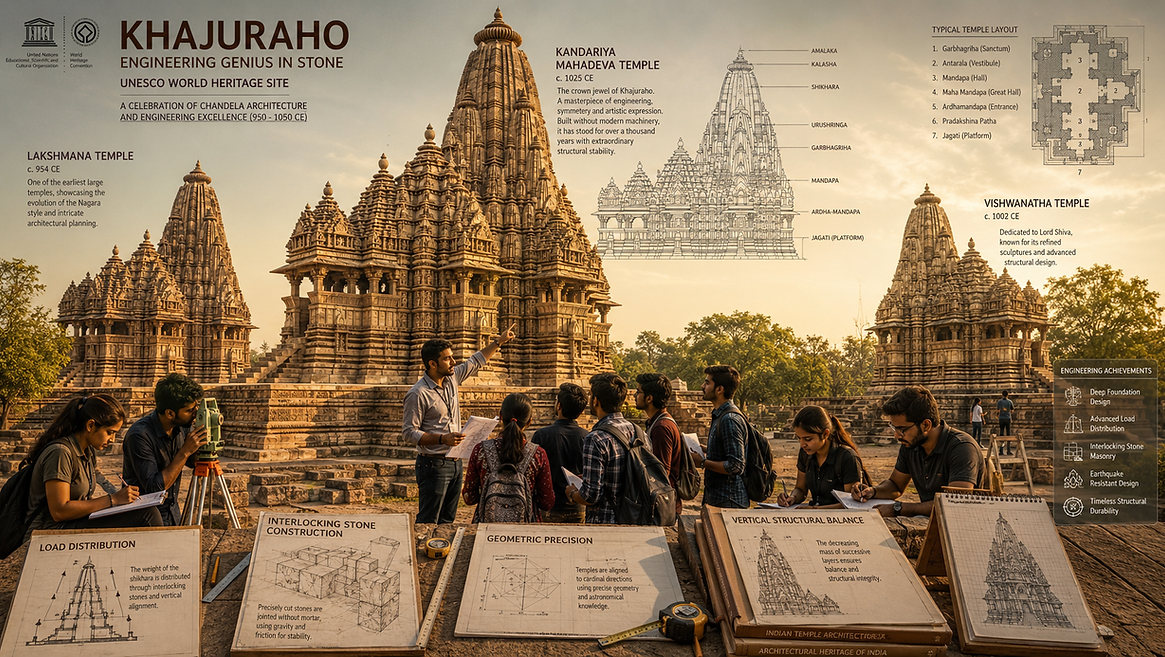
Christone Holidays
This educational travel image showcases Khajuraho as a living classroom for temple engineering and structural design. Featuring the Kandariya Mahadeva Temple, Lakshmana Temple and Vishwanatha Temple, students participate in architectural documentation, structural analysis, engineering observation and heritage interpretation activities. The image highlights ancient construction techniques, load distribution systems, foundation planning, geometric precision and architectural innovation that enabled these monumental structures to survive for over a thousand years. Through experiential learning, students gain practical insights into engineering, architecture and cultural heritage preservation.
Temple Engineering & Structural Design
Understanding How Ancient Builders Created Architectural Masterpieces That Have Endured for Centuries
How Were the Temples of Khajuraho Engineered and Constructed?
The temples of Khajuraho stand among the finest examples of ancient Indian engineering and architectural excellence. Built between the 9th and 12th centuries by the Chandela rulers, these remarkable structures were constructed without modern machinery, steel reinforcement, or concrete, yet they have remained standing for more than a thousand years. Their durability reflects a sophisticated understanding of structural engineering, geometry, material science, and architectural planning.
Strategic Site Selection The first stage of temple construction began with selecting suitable ground conditions. Ancient builders carefully chose stable sites that could support massive stone structures for centuries. Students Learn Importance of foundation stability. Relationship between geology and construction. Site selection in ancient architecture. Environmental considerations in planning. Educational Observation Students can observe how the temples were positioned within carefully planned complexes rather than being built randomly across the landscape. Elevated Platform Engineering Most Khajuraho temples stand on raised platforms known as Jagati. These platforms served multiple engineering purposes: Providing structural stability. Protecting the temple from water damage. Improving visibility and prominence. Creating a level construction base. Key Sites Kandariya Mahadeva Temple Lakshmana Temple Vishwanatha Temple Learning Outcome Students understand how foundation design remains one of the most critical elements of structural engineering. Interlocking Stone Construction One of the most fascinating engineering achievements of Khajuraho is the use of precisely cut sandstone blocks fitted together without extensive use of mortar. The stones were carefully shaped and assembled using: Gravity. Weight distribution. Interlocking joints. Precise stone fitting techniques. Students Explore Ancient construction technology. Precision stone masonry. Structural stability through design. Engineering without modern materials. Educational Insight Many joints remain remarkably intact after centuries, demonstrating exceptional craftsmanship and engineering precision. Load Distribution & Structural Balance The towering temple shikharas (spires) were designed to distribute weight efficiently through the structure. Builders understood how to: Transfer loads downward. Balance vertical forces. Reduce structural stress. Maintain long-term stability. Key Learning Sites Kandariya Mahadeva Temple Vishwanatha Temple Learning Outcome Students discover how engineering principles used in modern structures were already understood in ancient temple construction. Geometry & Mathematical Planning Khajuraho's temples were not only artistic masterpieces but also mathematical achievements. Architects applied: Symmetry. Proportional ratios. Geometric alignment. Spatial organisation. The placement of halls, sanctums, towers, and entrances followed carefully planned geometric principles. Students Learn Mathematics in architecture. Geometric design. Symmetry and balance. Architectural proportion. Educational Activity Students can identify repeating geometric patterns and analyse how mathematics shaped temple design. Vertical Engineering of the Shikhara The temple towers were designed to rise gracefully toward the sky while maintaining structural stability. The architects achieved this through: Progressive height reduction. Balanced weight distribution. Layered construction techniques. Repetitive architectural elements. Key Site Kandariya Mahadeva Temple Often regarded as the pinnacle of Chandela architectural engineering. Learning Outcome Students understand how ancient builders solved complex vertical construction challenges. Stone Craftsmanship & Construction Techniques Construction required thousands of skilled artisans, sculptors, engineers, and planners. The process included: Quarrying sandstone. Transporting stone blocks. Carving decorative elements. Assembling structural components. Integrating sculpture with architecture. Students Learn Traditional craftsmanship. Material science. Construction logistics. Collaborative engineering processes. Architectural Integration of Art & Engineering One of Khajuraho's greatest achievements is the seamless integration of artistic expression and structural design. The sculptures were not merely decorative additions; they were incorporated into the architectural framework itself. Students Explore Relationship between form and function. Engineering through aesthetics. Structural and artistic integration. Cultural storytelling through architecture. Key Educational Sites Kandariya Mahadeva Temple The finest example of Chandela engineering and architectural excellence. Lakshmana Temple Ideal for studying temple planning, platform engineering, and geometric design. Vishwanatha Temple Provides insights into structural organisation, spatial planning, and architectural balance. Educational Takeaway The temples of Khajuraho demonstrate that ancient Indian builders possessed advanced knowledge of engineering, mathematics, geometry, material science, and construction management. Through careful planning, precise stone craftsmanship, and sophisticated structural design, they created architectural masterpieces that continue to inspire engineers, architects, historians, and students from around the world. Key Learning Areas ✔ Structural Engineering ✔ Foundation Design ✔ Load Distribution Systems ✔ Geometry & Mathematical Planning ✔ Stone Masonry Techniques ✔ Architectural Design Principles ✔ Construction Management ✔ Heritage Conservation Khajuraho is therefore not only a UNESCO World Heritage Site but also a remarkable classroom where students can explore how science, engineering, mathematics, and creativity came together to create some of the world's most enduring architectural achievements.
Stone Craftsmanship & Sculpture Studies
Learning Through Art, Engineering & Human Creativity
This section helps students understand that the temples were not simply built—they were crafted by generations of master artisans, sculptors, architects, engineers and stoneworkers whose skills transformed sandstone into one of the world's greatest artistic achievements.
The temples of Khajuraho are often admired for their architectural grandeur, but equally remarkable is the extraordinary craftsmanship that covers nearly every surface of these monuments. Thousands of intricately carved sculptures, decorative panels, architectural motifs, and narrative scenes transform stone into a visual record of medieval Indian society.
For students, Khajuraho offers a rare opportunity to explore how traditional artisans combined technical skill, artistic imagination, cultural knowledge, and engineering precision to create sculptures that continue to inspire the world more than a thousand years later.
Every carving reveals lessons in design, craftsmanship, storytelling, material science, and cultural expression, making Khajuraho an exceptional classroom for art, architecture, archaeology, and heritage studies.


What Students Learn
Traditional Stone Carving Techniques
Students discover:
-
How sandstone was selected and prepared.
-
Traditional carving methods.
-
Hand tools used by artisans.
-
Sequential stages of sculpture creation.
-
Finishing and detailing techniques.
Material Science & Stone Durability
Students explore:
-
Properties of sandstone.
-
Weathering and erosion.
-
Preservation challenges.
-
Stone conservation methods.
-
Long-term monument survival.
Artistic Storytelling Through Sculpture
Students analyse how sculptures communicate:
-
Daily life.
-
Music and dance traditions.
-
Cultural values.
-
Religious beliefs.
-
Social structures.
Artisan Skills & Creative Processes
Students learn:
-
Design planning.
-
Artistic interpretation.
-
Visual storytelling.
-
Precision craftsmanship.
-
Collaboration between artisans and architects.
Sculpture Documentation & Observation
Students participate in:
-
Heritage photography.
-
Sketching exercises.
-
Sculpture analysis.
-
Documentation projects.
-
Cultural interpretation activities.
Artisan Skills & Creative Processes
Students learn:
-
Design planning.
-
Artistic interpretation.
-
Visual storytelling.
-
Precision craftsmanship.
-
Collaboration between artisans and architects.
Key Learning Sites
Kandariya Mahadeva Temple
Students study:
-
Intricate sculptural programmes.
-
Decorative architecture.
-
Artistic detailing.
-
Integration of sculpture and structure.
Lakshmana Temple
Students explore:
-
Narrative carvings.
-
Cultural symbolism.
-
Decorative panels.
-
Architectural ornamentation.
Khajuraho Archaeological Museum
Students examine:
-
Preserved sculptures.
-
Archaeological discoveries.
-
Conservation techniques.
-
Historical interpretation.
Western Group of Temples
Students observe:
-
Large-scale sculptural planning.
-
Artistic diversity.
-
Architectural integration.
-
Heritage conservation efforts.
Educational Takeaway
Khajuraho demonstrates that great architecture depends not only on engineering but also on the skill, creativity, and dedication of artisans. Through the study of sculpture and craftsmanship, students gain insights into art, culture, material science, heritage preservation, and the remarkable human ability to transform stone into enduring works of cultural significance.
Geometry & Mathematics in Architecture
Learning Through Design, Symmetry & Mathematical Precision
The temples of Khajuraho are not only masterpieces of art and engineering but also remarkable examples of mathematical thinking applied to architecture. Long before modern computer-aided design, the builders of Khajuraho used geometry, proportion, symmetry, measurement, and spatial planning to create structures that remain visually harmonious and structurally stable after more than a thousand years.
For students, Khajuraho offers a fascinating opportunity to discover how mathematics exists beyond textbooks and plays a vital role in architecture, design, engineering, and construction. Every temple reveals evidence of careful planning, geometric precision, and proportional relationships that guided the work of Chandela architects and master builders.
Key Learning Sites
Kandariya Mahadeva Temple
Study symmetry, vertical proportions, geometric planning and structural harmony.
Lakshmana Temple
Examine temple layouts, proportional design and architectural balance.
Chitragupta Temple
Explore spatial organisation and geometric relationships.
Signature Educational Experiences
Geometry Mapping Exercise
Students identify geometric patterns and symmetrical elements within temple architecture.
Architectural Measurement Workshop
Observing proportions, scale and structural relationships.
Temple Layout Analysis
Understanding how geometric planning influenced construction.
Architectural Sketching Session
Learning design principles through observation and drawing.
Khajuraho Geometry & Mathematics in Architecture | Educational Learning Experience

Students discover how geometry, symmetry and mathematical precision shaped the design and construction of Khajuraho's world-famous temples.
How Is Mathematics Used in the Architecture of Khajuraho Temples?
The temples of Khajuraho are among the finest examples of how mathematics and architecture work together to create structures that are both visually stunning and structurally stable. Built between the 9th and 12th centuries by the Chandela rulers, these temples demonstrate advanced knowledge of geometry, symmetry, proportion, measurement, and spatial planning long before modern engineering tools existed.
For students, Khajuraho offers a fascinating opportunity to see mathematics applied in the real world through architecture, design, and construction.
Symmetry and Visual Balance One of the most noticeable mathematical features of Khajuraho's temples is symmetry. The architects carefully designed the temples so that both sides mirror each other, creating harmony and balance. Students Learn Bilateral symmetry Visual balance Structural harmony Architectural alignment Key Sites Kandariya Mahadeva Temple Lakshmana Temple Geometric Planning Before construction began, architects used geometric layouts to plan the entire temple complex. Temple components such as: Sanctums Halls Entrances Courtyards Towers were arranged according to precise geometric principles. Students Learn Squares and rectangles in architecture Spatial geometry Layout planning Geometric organisation Educational Observation Students can identify geometric patterns within temple floor plans and architectural layouts. Proportion and Scale Ancient builders followed proportional relationships to ensure every element of the temple appeared visually harmonious. The height of towers, width of halls, size of entrances, and placement of sculptures all followed carefully calculated proportions. Students Learn Ratios and proportions Scale relationships Architectural composition Design harmony Educational Insight The pleasing appearance of Khajuraho's temples is largely the result of mathematical proportion. Vertical Mathematics of the Shikhara The soaring temple towers, known as shikharas, demonstrate sophisticated mathematical planning. The towers gradually reduce in size as they rise upward, creating: Visual rhythm Structural stability Balanced weight distribution Key Site Kandariya Mahadeva Temple Students can observe how mathematical scaling contributes to both beauty and engineering strength. Architectural Alignment The temples were carefully aligned within the landscape. Builders considered: Orientation Spatial relationships Movement through spaces Visual perspectives Students Learn Alignment principles Directional planning Architectural sequencing Human interaction with space Measurement and Construction Constructing a temple required accurate measurement and planning. Ancient architects used mathematical systems to determine: Building dimensions Structural proportions Placement of carvings Construction sequences Students Learn Measurement techniques Construction planning Precision in design Mathematical problem-solving Mathematics in Sculpture Placement Even the sculptures follow mathematical logic. The carvings are arranged in repeating patterns that create rhythm, balance, and visual continuity across the temple walls. Students Explore Pattern recognition Repetition and sequence Decorative geometry Visual organisation Key Learning Sites Kandariya Mahadeva Temple Study symmetry, proportions, tower design, and geometric planning. Lakshmana Temple Observe layout planning, proportional architecture, and balanced design. Chitragupta Temple Explore spatial organisation and architectural geometry. Educational Takeaway Khajuraho demonstrates that mathematics is much more than numbers and equations. It is a practical tool that helps architects design beautiful, functional, and long-lasting structures. Through symmetry, geometry, proportion, measurement, and spatial planning, the builders of Khajuraho created architectural masterpieces that continue to inspire engineers, architects, mathematicians, and students around the world. Key Learning Areas ✔ Symmetry & Balance ✔ Geometry in Architecture ✔ Ratios & Proportions ✔ Spatial Planning ✔ Architectural Alignment ✔ Measurement Systems ✔ Pattern Recognition ✔ Mathematical Design Principles Khajuraho is therefore an extraordinary outdoor classroom where students can experience how mathematics shapes architecture, engineering, art, and human creativity in one of India's greatest UNESCO World Heritage Sites.
Khajuraho UNESCO World Heritage Temple Gallery | Educational Learning Corridor
Explore the architectural, engineering and artistic achievements of Khajuraho's UNESCO World Heritage temples through an immersive educational journey featuring the most iconic monuments of the Chandela dynasty.

This panoramic educational gallery showcases the most significant temples of Khajuraho, one of India's most celebrated UNESCO World Heritage Sites. Featuring Kandariya Mahadeva Temple, Lakshmana Temple, Vishwanatha Temple, Chitragupta Temple, Devi Jagadambi Temple and Parsvanatha Temple, the image highlights the architectural brilliance, engineering precision, geometric planning, stone craftsmanship and artistic excellence of the Chandela period. Designed as part of the Christone Holidays Educational Learning Corridor, the gallery introduces students and travellers to the rich cultural, historical and educational value of Khajuraho while demonstrating why it remains one of the world's greatest heritage destinations.
Khajuraho UNESCO World Heritage Temple Gallery
Exploring the Architectural, Engineering and Artistic Legacy of the Chandela Dynasty
Khajuraho originally had around 85 temples built by the Chandela rulers between approximately 950 CE and 1050 CE.
Today, only about 20–25 temples survive, with most sources citing 22 well-preserved temples spread across three main groups.
Temple Groups in Khajuraho Western Group of Temples (Most Important) This is the main UNESCO heritage complex and contains the most famous temples. Key temples include: Kandariya Mahadeva Temple Lakshmana Temple Vishwanatha Temple Chitragupta Temple Devi Jagadambi Temple Matangeshvara Temple Eastern Group of Temples Important temples include: Parsvanatha Temple Adinatha Temple Ghantai Temple This group is especially useful for: Jain philosophy studies Religious diversity Heritage conservation Southern Group of Temples Important temples include: Duladeo Temple Chaturbhuja Temple Useful for: Late Chandela architecture Architectural evolution studies
Art, Symbolism & Cultural Narratives
Learning Through Storytelling in Stone
The temples of Khajuraho are among the world's most remarkable examples of visual storytelling. Every sculpture, carving, and decorative panel serves as a historical record, preserving the cultural, social, artistic, and spiritual life of medieval India. Rather than relying solely on written texts, the artisans of the Chandela period used stone as a medium to communicate ideas, traditions, beliefs, and everyday experiences.
For students, Khajuraho offers a unique opportunity to understand how art functions as a language that transcends generations. The temple walls become an open-air museum where stories of music, dance, community life, spirituality, and cultural identity continue to educate visitors more than a thousand years after their creation.
What Students Learn
Storytelling Through Visual Art
Students discover how sculptures communicate complex ideas without words.
Learning Outcomes
-
Visual communication
-
Narrative interpretation
-
Symbolic storytelling
-
Historical documentation
-
Cultural expression
Music, Dance & Performing Arts
The carvings preserve valuable evidence of medieval performing arts traditions.
Students Explore
-
Traditional musical instruments
-
Classical dance traditions
-
Performance culture
-
Artistic expression
-
Cultural celebrations
Social Life & Daily Activities
The sculptures provide a fascinating glimpse into everyday life during the Chandela period.
Students Observe
-
Family life
-
Occupations and professions
-
Community interactions
-
Festivals and ceremonies
-
Traditional lifestyles
Art as Historical Evidence
The sculptures act as historical documents that help scholars understand past societies.
Students Learn
-
Historical interpretation
-
Cultural reconstruction
-
Archaeological observation
-
Heritage documentation
-
Visual analysis
Spiritual Symbolism
Students learn how artistic symbols were used to communicate philosophical and spiritual ideas.
Learning Topics
-
Symbolic representation
-
Religious traditions
-
Sacred architecture
-
Cultural beliefs
-
Visual symbolism
Key Learning Sites
Kandariya Mahadeva Temple
Lakshmana Temple
Chitragupta Temple
Duladeo Temple
Educational Takeaway
Khajuraho teaches students that art is more than decoration. It is a powerful tool for preserving knowledge, communicating values, documenting history, and expressing cultural identity. Through the study of symbolism and visual narratives, students gain a deeper appreciation of how societies use creativity to record and transmit knowledge across generations.

Art, Symbolism & Cultural Narratives
Learning How the Past is Protected for the Future
Khajuraho is not only a UNESCO World Heritage Site but also a living example of heritage conservation in action. The survival of these temples for over a thousand years is the result of careful preservation, scientific restoration, archaeological research, and responsible tourism management.
For students, Khajuraho provides a valuable opportunity to understand how governments, conservation specialists, archaeologists, local communities, and international organisations work together to safeguard cultural heritage for future generations.
What Students Learn
Heritage Conservation Principles
Students understand why historic monuments require protection.
Learning Outcomes
-
Cultural preservation
-
Heritage significance
-
Conservation ethics
-
Responsible tourism
-
Sustainable heritage management
Archaeological Research
Students explore how archaeologists study and document ancient monuments.
Topics Covered
-
Archaeological surveys
-
Monument documentation
-
Historical interpretation
-
Site recording
-
Heritage research
Restoration Techniques
Students learn how damaged structures are stabilised and preserved.
Learning Areas
-
Stone conservation
-
Structural repairs
-
Preventive maintenance
-
Scientific restoration
-
Preservation planning
Environmental Challenges
Students examine the factors that threaten heritage sites.
Students Explore
-
Weathering
-
Pollution
-
Visitor impact
-
Biological growth
-
Climate influences
UNESCO World Heritage Protection
Students understand how international recognition supports conservation efforts.
Learning Topics
-
UNESCO standards
-
Global heritage protection
-
Site management
-
Cultural sustainability
-
Heritage tourism
Signature Educational Experiences
-
Heritage Documentation Workshop
-
Conservation Observation Exercise
-
Archaeology Introduction Session
-
Monument Preservation Study
-
Responsible Tourism Discussion
Key Learning Sites
Western Group of Temples
Study active conservation practices and monument management.
Eastern Group of Temples
Observe preservation of religious heritage.
Southern Group of Temples
Understand long-term conservation challenges.
Khajuraho Archaeological Museum
Learn about archaeological discoveries and preservation efforts.
Educational Takeaway
Khajuraho demonstrates that preserving heritage is a shared responsibility. Students gain insight into how scientific research, conservation planning, community participation, and responsible tourism work together to ensure that future generations can continue learning from these extraordinary monuments.

RANEH FALLS
Learning Through Geology, Volcanic Landscapes & River Erosion
Where Earth's Ancient History Meets the Ken River
Located approximately 20 kilometres from Khajuraho, Raneh Falls is one of India's most remarkable geological landscapes. Unlike conventional waterfalls known primarily for their height or water volume, Raneh Falls is celebrated for its dramatic canyon, multi-coloured granite formations, ancient volcanic features, and the erosive power of the Ken River.
For students, Raneh Falls serves as a natural outdoor laboratory where geology, geography, environmental science, hydrology, and biodiversity can be studied in a real-world setting. The site reveals millions of years of Earth's geological history through exposed rock formations, river-carved gorges, and volcanic remnants that continue to fascinate scientists, educators, and nature enthusiasts.
Raneh Falls Raneh Falls is a natural waterfall on the Ken River, located near Khajuraho in Chhatarpur district, Madhya Pradesh, India. The falls cascade through a striking granite canyon often called the “Grand Canyon of India,” making it a major eco-tourism and scenic attraction in central India. Key facts River: Ken River Height of canyon: ~30 m (98 ft) Length of gorge: ~5 km (3 mi) Distance from Khajuraho: ~20–23 km Best visiting season: Post-monsoon (September–November) Geological and scenic features Raneh Falls lies where the Ken River cuts into volcanic and crystalline granite, revealing vivid rock layers in pink, red, and grey tones. The gorge extends for about five kilometers and plunges up to thirty meters deep. Its multicolored cliffs, smaller seasonal cascades, and shimmering pools create a dramatic landscape that changes character with the seasons. During monsoon, the river roars through the canyon, while in drier months it forms quieter streams revealing intricate rock textures. Ecology and nearby sanctuary The falls form part of the Ken Gharial Sanctuary, a protected area established to conserve endangered gharials and muggers. The sanctuary’s riverine ecosystem also supports birds, chinkara, blue bull, and other wildlife. Boat rides and guided safaris (outside the monsoon closure) offer visitors glimpses of these species along the Ken and Khudar river confluence. Visitor information Entry to Raneh Falls is managed by the local forest department, typically open from 8 a.m. – 5 p.m., with modest entry and vehicle fees. Viewing platforms and safety railings line the rim, providing panoramic photo points without major trekking. The site is best accessed via taxi from Khajuraho or Rajnagar, taking roughly 40 minutes each way. Cultural and travel context Named after regional ruler King Rane Pratap, the falls provide a natural complement to the sculpted temples of Khajuraho Group of Monuments. Travelers often pair a temple tour in the morning with a nature excursion to Raneh Falls in the afternoon, experiencing both the artistic and geological wonders that define Madhya Pradesh’s heartland.
Raneh Falls Geology & River Erosion Learning Experience
Raneh Falls offers students a rare opportunity to study canyon formation, geological history, volcanic landscapes and river erosion within one of Central India's most fascinating natural classrooms.

This educational image showcases the dramatic geological landscape of Raneh Falls, where the Ken River has carved a deep canyon through ancient granite formations over millions of years. As part of the Christone Holidays Educational Learning Corridor, students explore geology, hydrology, environmental science and biodiversity through hands-on field observation. The site serves as a natural bridge between the heritage wonders of Khajuraho and the wildlife-rich landscapes of Panna, making it one of the most valuable outdoor classrooms in Central India.
What Can Students Learn at Raneh Falls?
Geological Formation & Earth's History
The exposed rock formations at Raneh Falls provide valuable insights into the geological evolution of Central India.
Students Learn
-
Formation of igneous rocks
-
Geological timescales
-
Earth's crust development
-
Rock weathering processes
-
Landscape evolution
Educational Value
Students gain a practical understanding of concepts often taught only through diagrams and textbooks.
Granite Canyon Formation
One of the most distinctive features of Raneh Falls is its spectacular canyon carved by the Ken River.
Students Explore
-
Canyon development
-
River erosion
-
Water-driven landscape changes
-
Rock exposure processes
-
Geological transformation over time
Learning Outcome
Understanding how rivers continuously reshape the Earth's surface.
Volcanic Landscapes & Ancient Lava Activity
Evidence suggests that parts of the region experienced volcanic activity in the distant geological past.
Students Study
-
Volcanic landforms
-
Lava cooling processes
-
Igneous rock formation
-
Geological disturbances
-
Ancient Earth processes
Hydrology & River Systems
The Ken River serves as an excellent example of river dynamics and watershed systems.
Students Learn
-
River flow patterns
-
Seasonal water variation
-
Erosion and deposition
-
Water resource systems
-
Watershed management
Biodiversity Along River Ecosystems
The surrounding landscape supports diverse flora and fauna.
Students Observe
-
Riverine vegetation
-
Birdlife
-
Small wildlife
-
Habitat diversity
-
Ecosystem interactions
This creates a natural educational bridge into Panna Tiger Reserve.
Key Learning Areas
Geology
Geography
Environmental Science
Hydrology
Earth Sciences
Biodiversity Studies
Conservation Awareness
Educational Takeaway
Raneh Falls demonstrates that landscapes are constantly evolving. Through the interaction of rock, water, climate, and time, nature has created one of India's most striking geological classrooms. Students leave with a deeper understanding of Earth's history, natural processes, and the powerful forces that continue to shape our planet.
From Stone Temples to Living Landscapes
The educational journey now moves beyond the architectural masterpieces of Khajuraho and the geological wonders of Raneh Falls into the forests and river valleys of Panna. Here, students transition from studying human history and engineering to exploring wildlife conservation, diamond geology, biodiversity, community livelihoods, and sustainable tourism.
Panna is more than a wildlife destination—it is a living classroom where nature, science, culture, and conservation come together to create meaningful experiential learning opportunities.
PANNA
Learning Through Geology, Diamond Exploration, Wildlife Conservation & Community Sustainability
The signature educational experience of the entire Madhya Pradesh Learning Corridor.
-
Geology | Diamond Exploration | Wildlife Conservation | Biodiversity | Community Development | Traditional Crafts | Sustainable Tourism | Experiential Learning
PANNA
Learning Through Geology, Diamond Exploration, Wildlife Conservation & Community Sustainability
Where Nature, Science, Conservation and Community Come Together
Nestled within the heart of Bundelkhand, Panna Tiger Reserve offers one of India's most diverse experiential learning environments. While widely known for its tiger conservation success story, Panna is also a region of immense geological significance, rich biodiversity, diamond-bearing landscapes, traditional communities, and sustainable tourism initiatives.
For students, Panna serves as a living classroom where science, geography, ecology, conservation, culture, and community development can be explored through direct observation and hands-on experiences. From understanding how diamonds form deep within the Earth to studying wildlife conservation and community livelihoods, every experience contributes to a deeper appreciation of the interconnected relationship between people and nature.
Unlike conventional sightseeing destinations, Panna encourages learners to actively engage with landscapes, ecosystems, local traditions, and conservation initiatives, creating meaningful educational experiences that remain long after the journey ends.
Panna Tiger Reserve Panna Tiger Reserve, located in Panna and Chhatarpur districts of northern Madhya Pradesh, India, is a protected area within the Vindhyan Range. Established as a national park in 1981 and declared India’s 22nd Tiger Reserve in 1994, it is renowned for its remarkable tiger conservation success story and striking natural landscapes. Key facts Area: 1,645 sq km (core: 543 sq km; buffer: 1,002 sq km) Established: National Park (1981); Tiger Reserve (1994) UNESCO Status: Biosphere Reserve (2020) Location: Vindhyan Range, Panna & Chhatarpur districts, Madhya Pradesh Best visiting months: November–March Geography and Ecology The reserve lies at the junction of the Gangetic plains and Deccan Plateau, marked by plateaus, deep gorges, and the perennial Ken River. The terrain features tropical dry deciduous forests dominated by teak and kardhai (Anogeissus pendula) trees, interspersed with grasslands and rocky outcrops. It provides critical ecological connectivity between eastern and western wildlife populations of central India. Wildlife Panna supports over 40 mammal species and 300 bird species. Apart from Bengal tigers, it hosts leopards, sloth bears, nilgai, sambar, chinkara, and four-horned antelope. The Ken River sustains marsh crocodiles and gharials, while raptors such as red-headed and Indian vultures thrive here. It is also known for rich avifauna, including paradise flycatchers and bar-headed geese. Conservation and Recognition Once stripped of tigers by 2009 due to poaching, Panna became a model for tiger reintroduction. Translocated individuals from Bandhavgarh Tiger Reserve, Kanha Tiger Reserve, and Pench Tiger Reserve helped restore a thriving population—now exceeding 50 tigers. The reserve received the “Best Maintained National Park” award from India’s Ministry of Tourism in 2007 and was later included in UNESCO’s World Network of Biosphere Reserves. Tourism and Access Visitors enter through gates such as Madla and Hinauta. Safaris—by jeep, boat, or at night in buffer zones—offer sightings of tigers and scenic highlights like Pandav Falls and Raneh Falls. The nearest airport is at Khajuraho, about 25–45 km away, linking Panna to major Indian cities. The reserve remains open to visitors from mid-October to June, closing during the monsoon season.
Panna Educational Learning Experience | Geology, Wildlife & Sustainability
Panna offers a unique educational journey where students explore diamond geology, wildlife conservation, biodiversity, traditional crafts and sustainable community livelihoods through immersive experiential learning.

This educational hero image introduces Panna as a multidisciplinary learning destination where geology, wildlife conservation, biodiversity, sustainability and community development intersect. Students engage in hands-on experiences ranging from diamond exploration and wildlife observation to traditional crafts and sustainable tourism initiatives. As part of the Christone Holidays Educational Learning Corridor, Panna provides one of Central India's most comprehensive outdoor learning environments.
What Can Students Learn in Panna?
Diamond Geology & Earth's Hidden Treasures
Panna is India's only active diamond-producing region, making it one of the country's most fascinating geological learning destinations.
Students explore:
-
Diamond formation processes
-
Geological timescales
-
Mineral resources
-
Rock formations
-
Mining history
-
Sustainable resource management
Wildlife Conservation & Tiger Recovery
Panna is internationally recognised for one of India's most successful tiger conservation stories.
Students learn:
-
Wildlife management
-
Species conservation
-
Ecosystem restoration
-
Habitat protection
-
Human-wildlife coexistence
-
Conservation science
Biodiversity & Ecosystem Studies
The reserve supports a rich diversity of flora and fauna.
Students observe:
-
Forest ecosystems
-
Predator-prey relationships
-
Birdlife
-
River ecosystems
-
Habitat diversity
-
Ecological balance
Community Livelihoods & Sustainable Tourism
Students discover how conservation and local communities can work together.
Learning areas include:
-
Community-based tourism
-
Sustainable livelihoods
-
Traditional knowledge
-
Rural entrepreneurship
-
Conservation-linked income generation
Traditional Arts & Cultural Heritage
Experiences such as block printing and local crafts demonstrate how traditional skills contribute to community development and cultural preservation.
Experiential Learning & Outdoor Education
Panna transforms learning from theory into experience.
Students engage in:
-
Field observation
-
Nature walks
-
Wildlife interpretation
-
Geological exploration
-
Cultural interaction
-
Sustainability studies
Key Learning Pillars of Panna
1. Diamond Exploration & Geology
2. Wildlife Conservation & Tiger Ecology
3. Biodiversity & Environmental Science
4. Community Sustainability
5. Traditional Crafts & Cultural Heritage
6. Experiential Outdoor Learning
Explore Panna through immersive educational experiences designed with local conservationists, artisans, community members, and nature experts.
Signature Educational Experiences
The following experiences will become dedicated learning modules:
Diamond Exploration Experience
Panna Tiger Reserve Wildlife Safari
Nature Walks & Birding Studies
Tiger Block Printing Workshop
Bundelkhandi Culinary Heritage Experience
House of GK Homestay Learning Experience
Community & Sustainability Learning
PANNA SIGNATURE EXPERIENCES
Exclusive Experiential Learning Programs by Christone Holidays
Learning Beyond Observation — Engaging with Panna's People, Wildlife, Geology and Traditions
Panna is not a destination to be merely seen; it is a destination to be experienced. Through carefully curated educational programs, students move beyond traditional sightseeing and become active participants in learning. These immersive experiences connect learners with local communities, conservation efforts, traditional crafts, geological heritage, and the natural ecosystems that define this remarkable landscape.
Developed in collaboration with local experts, artisans, conservation stakeholders and community partners, these experiences provide meaningful opportunities to learn through participation, observation and interaction.
HOUSE OF GK HOMESTAY
Learning Through Community Living & Sustainable Rural Tourism
Hidden within the natural landscapes surrounding Panna Tiger Reserve, the House of GK Homestay offers students an opportunity to experience authentic Bundelkhand hospitality while gaining insights into sustainable tourism, community livelihoods and rural life.
Unlike conventional accommodation, the homestay becomes part of the learning experience itself.
What Makes This Experience Unique?
Strategic Location for Learning
The property lies at the centre of Panna's major conservation zones.
-
Approximately one minute from Hinota Gate.
-
Around twenty minutes from Madla Gate.
-
Around twenty minutes from Akola Gate.
This allows students to access multiple ecosystems and conservation zones efficiently.
Living Classroom Environment
The campus itself functions as a biodiversity learning space.
Students can explore:
-
Natural waterholes.
-
Bird habitats.
-
Nature trails.
-
Forest-edge ecosystems.
-
Rural landscapes.
Country Living Experiences
Students participate in:
-
Cycling through village landscapes.
-
Nature-based recreation.
-
Fishing demonstrations where appropriate.
-
Environmental observation.
-
Community interaction activities.
Learning Outcomes
-
Sustainable tourism
-
Rural livelihoods
-
Community-based conservation
-
Nature interpretation
-
Responsible travel
DIAMOND EXPLORATION EXPERIENCE
Learning Through Geology, Mining Heritage & Resource Management
Panna occupies a unique place in India's geological history as the country's only active diamond-producing region.
This hands-on educational experience introduces students to the fascinating story of how diamonds form deep within the Earth and how geology influences both landscapes and livelihoods.
Unlike classroom-based learning, students engage directly with the region's geological identity.
What Students Learn
The Science Behind Diamonds
Students discover:
-
How diamonds are formed.
-
Geological timescales.
-
High-pressure Earth processes.
-
Mineral formation.
-
Diamond-bearing rock systems.
Panna's Diamond Heritage
Students explore:
-
Historical diamond discoveries.
-
Traditional mining practices.
-
Resource management.
-
Economic geography.
-
Geological significance of Bundelkhand.
Learning Outcomes
-
Earth Sciences
-
Geology
-
Mineral Resources
-
Economic Geography
-
Sustainable Development
Experiential Learning Activities
Students may participate in:
-
Geological observation exercises.
-
Mineral identification sessions.
-
Interactive discussions with local experts.
-
Landscape interpretation activities.
-
Educational demonstrations related to diamond exploration.
WILDPINES TIGER BLOCK PRINTING EXPERIENCE
Learning Through Traditional Craft, Culture & Community Empowerment
Within the Wildpines Craft Centre, students encounter a remarkable example of how traditional skills, conservation awareness and community development can work together.
The block printing initiative is led largely by members of local tribal communities, including women artisans who transform traditional knowledge into sustainable livelihoods.
Hands-On Learning Experience
Students do not simply observe.
They actively participate in:
-
Block printing demonstrations.
-
Design creation.
-
Pattern development.
-
Natural dye understanding.
-
Traditional textile techniques.
Understanding Community Empowerment
Students learn how craft initiatives support:
-
Women's livelihoods.
-
Tribal entrepreneurship.
-
Cultural preservation.
-
Sustainable income generation.
-
Conservation-linked development.
Learning Outcomes
-
Traditional Arts
-
Entrepreneurship
-
Social Sustainability
-
Cultural Heritage
-
Community Development
BUNDELKHANDI CULINARY HERITAGE EXPERIENCE
Learning Through Food, Culture & Traditional Knowledge
Food tells the story of a region's history, climate, agriculture and culture.
At Panna, students experience authentic Bundelkhandi cuisine prepared using local ingredients, traditional recipes and generations of culinary knowledge.
Often served beneath the shade of majestic Mahua trees, the experience creates a direct connection between people, landscape and heritage.
What Students Learn
-
Regional food systems.
-
Traditional agriculture.
-
Sustainable food practices.
-
Cultural identity through cuisine.
-
Local ingredients and seasonal cooking.
Experiential Elements
Students explore:
-
Traditional cooking methods.
-
Local ingredients.
-
Food heritage discussions.
-
Cultural dining experiences.
-
Community hospitality.
Learning Outcomes
-
Food Geography
-
Cultural Studies
-
Sustainable Agriculture
-
Community Traditions
-
Culinary Heritage
NATURE WALKS & BIRDING EXPERIENCE
Learning Through Biodiversity & Ecosystem Observation
The forest-edge location of the campus provides exceptional opportunities for nature interpretation and biodiversity studies.
Guided walks transform the surrounding landscape into an outdoor classroom.
What Students Observe
-
Native bird species.
-
Seasonal migratory birds.
-
Forest ecosystems.
-
Waterhole biodiversity.
-
Plant-animal interactions.
Educational Activities
Students participate in:
-
Bird identification.
-
Habitat observation.
-
Biodiversity recording.
-
Nature journaling.
-
Ecological interpretation.
Learning Outcomes
-
Biodiversity Studies
-
Environmental Science
-
Ecology
-
Wildlife Observation
-
Conservation Awareness
Why These Experiences Matter
These signature experiences transform Panna from a wildlife destination into a comprehensive experiential learning environment.
Students do not merely visit a tiger reserve. They:
-
Explore geology through diamond landscapes.
-
Understand conservation through biodiversity.
-
Experience sustainability through community initiatives.
-
Learn traditional crafts through participation.
-
Discover local culture through cuisine.
-
Engage directly with nature through observation and exploration.
Together, these experiences create one of the most immersive educational travel programs available in Central India and represent the heart of the Christone Holidays learning philosophy:
Learning Beyond Boundaries. Experiencing Beyond Destinations.
PANNA TIGER RESERVE WILDLIFE SAFARI
Learning Through Wildlife Conservation, Ecosystem Management & Biodiversity Studies
Understanding One of India's Greatest Wildlife Conservation Success Stories
A wildlife safari in Panna Tiger Reserve is far more than a search for tigers. It is an immersive field-learning experience that introduces students to the complex relationships between wildlife, habitats, conservation efforts, and sustainable ecosystem management.
Spread across diverse forests, grasslands, river systems, and rocky landscapes, Panna Tiger Reserve provides an exceptional outdoor classroom where students can observe ecological processes in action and gain first-hand insights into wildlife conservation.
Perhaps most importantly, Panna represents one of India's most inspiring conservation success stories. After losing its tiger population in the early 2000s, dedicated conservation initiatives helped restore the reserve into one of the country's thriving tiger habitats. Today, it stands as a remarkable example of how science, conservation planning, habitat protection, and community participation can reverse ecological decline.
What Students Learn During the Safari
Wildlife Conservation in Practice
Students gain a deeper understanding of how conservation programs protect endangered species and maintain ecological balance.
Learning Areas
-
Tiger conservation
-
Wildlife protection strategies
-
Habitat restoration
-
Species monitoring
-
Conservation challenges
-
Protected area management
Understanding Ecosystems
The reserve allows students to observe how different species interact within a healthy ecosystem.
Students Explore
-
Food chains
-
Food webs
-
Predator-prey relationships
-
Ecosystem balance
-
Species interdependence
-
Natural resource cycles
Biodiversity Studies
Panna supports a wide range of wildlife beyond tigers.
Students May Observe
-
Leopards
-
Deer species
-
Nilgai
-
Wild boar
-
Sloth bears
-
Crocodiles
-
Numerous bird species
-
Reptiles and smaller mammals
Each observation becomes an opportunity to understand biodiversity and ecological adaptation.
Habitat Diversity
Students learn how different habitats support different species.
Habitats Explored
-
Dry deciduous forests
-
Riverine ecosystems
-
Grasslands
-
Rocky plateaus
-
Wetland environments
Wildlife Tracking & Observation Skills
Students learn basic field techniques used by naturalists and conservationists.
Educational Activities
-
Animal behaviour observation
-
Track and sign identification
-
Habitat interpretation
-
Wildlife recording
-
Ethical wildlife viewing
Signature Learning Experiences
Guided Interpretation Safari
Expert naturalists help students understand wildlife behaviour, ecological relationships, and conservation strategies.
Biodiversity Observation Exercise
Students document species encountered during the safari and discuss their ecological roles.
Ecosystem Mapping Activity
Understanding how forests, rivers, grasslands, and wildlife interact to form a healthy ecosystem.
Conservation Discussion Session
Exploring the challenges and successes of wildlife conservation in modern India.
Why Panna is a Conservation Success Story
One of the most valuable lessons for students is understanding how conservation can create positive change.
Panna demonstrates:
-
Scientific wildlife management
-
Habitat restoration
-
Species recovery programs
-
Community participation
-
Sustainable conservation planning
The reserve's recovery serves as an inspiring example of environmental stewardship and responsible resource management.
Educational Outcomes
Students develop an understanding of:
-
Wildlife ecology
-
Conservation biology
-
Environmental science
-
Biodiversity management
-
Sustainable development
-
Protected area conservation
-
Human-nature relationships
Educational Takeaway
The Panna Tiger Reserve Wildlife Safari transforms a traditional wildlife excursion into a meaningful conservation learning experience. Students leave with a greater appreciation of biodiversity, ecological balance, and the vital role conservation plays in protecting natural heritage for future generations. More importantly, they witness how dedicated conservation efforts can restore ecosystems and create a sustainable future for both wildlife and local communities.
PANNA SIGNATURE EXPERIENCES


The Central India Geology, Wildlife & Heritage Learning Corridor
Jabalpur → Marble Rocks → Panna → Khajuraho
Exploring River Landscapes, Geological Wonders, Wildlife Conservation and UNESCO Heritage Across Central India.
Central India is home to some of India's most extraordinary natural and cultural landscapes. This educational learning corridor connects the geological marvels of Jabalpur and Bhedaghat, the conservation landscapes of Panna, and the architectural masterpieces of Khajuraho into one immersive experiential journey.
Unlike traditional tours that focus primarily on sightseeing, this corridor is designed around learning through exploration. Students travel through landscapes shaped by ancient rivers, volcanic activity, geological transformations, thriving ecosystems, and centuries of human creativity.
The journey begins in Jabalpur, where the Narmada River has sculpted dramatic marble canyons and powerful waterfalls, creating a natural laboratory for Earth Sciences, Geography and Hydrology. Moving through the geological landscapes of Bhedaghat and the famous Marble Rocks, students witness millions of years of geological history exposed in spectacular formations.
The learning experience then continues into the forests and conservation landscapes of Panna, where wildlife protection, biodiversity, diamond geology, community sustainability and experiential education come together in one of India's most remarkable outdoor classrooms.
The corridor concludes at Khajuraho, a UNESCO World Heritage Site celebrated for its architectural brilliance, mathematical precision, artistic excellence and cultural heritage. Here, students discover how engineering, geometry, craftsmanship and storytelling were transformed into enduring monuments that continue to inspire the world.
Together, these destinations create a multidisciplinary educational experience that connects Earth Sciences, Environmental Studies, Conservation, History, Architecture and Cultural Heritage into one meaningful learning journey.

This hero image showcases the spectacular Marble Rocks and Bhedaghat region near Jabalpur, where the Narmada River has carved a dramatic marble canyon over millions of years. Students engage in field-based learning, exploring geological formations, river systems, erosion processes and hydrology. The image also highlights Dhuandhar Falls and the historic Chausath Yogini Temple, demonstrating the connection between natural landscapes and cultural heritage. As part of the Christone Holidays Central India Geology, Wildlife & Heritage Learning Corridor, Marble Rocks serves as one of India's finest outdoor classrooms for Earth Sciences and Geography.
Learning Themes
What Students Will Explore
Geology & Earth Sciences
Understanding rock formations, geological processes, river erosion and landscape evolution.
River Systems & Hydrology
Exploring the Narmada and Ken River ecosystems and their influence on landscapes and communities.
Wildlife Conservation
Learning about biodiversity, habitat management and one of India's successful tiger conservation landscapes.
Sustainability & Community Learning
Experiencing how conservation, local livelihoods and responsible tourism work together.
Architecture & Engineering
Discovering ancient construction techniques, geometry and UNESCO World Heritage monuments.
Experiential Education
Learning through observation, participation, field studies and community engagement.
Route Overview
Route Map
Jabalpur → Marble Rocks → Panna → Khajuraho
Suggested Duration
5 Nights / 6 Days
Best For
-
Educational Tours
-
School Groups
-
College Expeditions
-
Geography Students
-
Environmental Science Students
-
Heritage & Architecture Studies
-
Experiential Learning Programs
JABALPUR
Learning Through History, Geology & Urban Heritage
Often called the cultural capital of Madhya Pradesh, Jabalpur serves as the gateway to Central India's geological wonders. Situated along the sacred Narmada River, the city combines history, indigenous heritage and fascinating geological features.
Students begin their journey by exploring the region's historical landmarks, geological formations and cultural heritage before entering the spectacular landscapes of Bhedaghat and Marble Rocks.
Key Learning Areas
-
Gond Kingdom History
-
Indigenous Heritage
-
Urban Development
-
Geological Processes
-
Natural Rock Formations
-
Regional Culture
Places to Explore
Madan Mahal Fort
Learning Themes:
-
Medieval History
-
Strategic Defence
-
Fort Architecture
-
Gond Dynasty Heritage
Balancing Rock
Learning Themes:
-
Weathering Processes
-
Geological Stability
-
Rock Formations
-
Earth Sciences
Rani Durgavati Museum
Learning Themes:
-
Archaeology
-
Tribal Cultures
-
Regional Heritage
-
Historical Preservation
What can students learn in Jabalpur?
Students explore indigenous history, geology, urban development, fort architecture and cultural heritage while gaining insights into the evolution of Central India.
MARBLE ROCKS & BHEDAGHAT
Learning Through Rivers, Rocks & Geological Time
• Marble Rocks
-
Narmada River Canyon
-
Dhuandhar Falls
-
Chausath Yogini Temple
-
River Geology
-
Hydrology
-
Landscape Evolution

This educational hero image showcases the spectacular Marble Rocks and Bhedaghat region of Jabalpur, Madhya Pradesh. Towering marble cliffs rise along the Narmada River, illustrating millions of years of geological history and river erosion. The image highlights key learning destinations including the Marble Rocks Canyon, Dhuandhar Falls and the historic Chausath Yogini Temple. Students engage in field-based exploration, studying Earth Sciences, hydrology, landscape evolution, environmental studies and cultural heritage. As part of the Christone Holidays Central India Geology, Wildlife & Heritage Learning Corridor, Bhedaghat serves as a unique destination where natural wonders and educational experiences come together.
What can students learn at Marble Rocks and Bhedaghat in Jabalpur?
Students can explore geological formations, metamorphic rocks, river erosion, hydrology, landscape evolution, environmental science and cultural heritage while experiencing the Marble Rocks canyon, Dhuandhar Falls and the Narmada River ecosystem firsthand.
Learning Through Rivers, Rocks & Geological Time
Where the Narmada River Reveals Millions of Years of Earth's History
Just outside Jabalpur lies one of India's most spectacular geological landscapes. At Bhedaghat, the mighty Narmada River flows through a dramatic canyon of towering marble cliffs, creating a natural classroom where students can witness the power of geological processes that have shaped the Earth over millions of years.
The Marble Rocks of Bhedaghat are not only a visual wonder but also an important educational destination for understanding geology, hydrology, river systems, erosion, landscape evolution and environmental studies. Combined with the thunderous Dhuandhar Falls and the historic Chausath Yogini Temple, the region offers a unique blend of natural and cultural learning experiences.
For students, Bhedaghat becomes a living laboratory where textbooks come alive through direct observation of rocks, rivers and natural forces at work.
What Can Students Learn at Marble Rocks & Bhedaghat?
Geology & Earth Sciences
Understand how marble rocks are formed through geological transformation over millions of years.
River Systems & Hydrology
Observe how rivers shape landscapes through erosion, transportation and deposition.
Landscape Evolution
Study how valleys, canyons and waterfalls develop over geological timescales.
Environmental Science
Explore the relationship between rivers, ecosystems and surrounding habitats.
Cultural Heritage
Discover how human settlements and religious sites evolved alongside the Narmada River.
Key Learning Experiences
Marble Rocks Canyon
Learning Through Geological Formations & River Erosion
The Marble Rocks are among India's most remarkable geological formations. Rising dramatically on both sides of the Narmada River, these towering cliffs create a breathtaking marble gorge that stretches through the landscape.
A boat journey through the canyon allows students to closely observe the unique textures, colours and structures of the marble formations.
What Students Learn
-
Formation of marble rocks
-
Metamorphic rock processes
-
Geological timescales
-
River erosion
-
Canyon formation
-
Natural weathering processes
Educational Outcome
Students gain first-hand understanding of how geological forces continuously shape the Earth's surface.
Narmada River Learning Experience
Understanding One of India's Great River Systems
The Narmada River is one of India's most important west-flowing rivers and has played a vital role in shaping the geography, ecosystems and cultures of Central India.
As students observe the river flowing through the marble canyon, they learn how rivers influence landscapes, biodiversity and human civilisation.
Learning Themes
-
River ecosystems
-
Watersheds
-
Hydrological cycles
-
River geomorphology
-
Human-river relationships
-
Sustainable water resources
Dhuandhar Falls
Learning Through Water Power & Landscape Evolution
The famous Dhuandhar Falls demonstrates the immense power of moving water. As the Narmada River narrows and plunges over rocky formations, a spectacular waterfall is created, producing a mist that resembles rising smoke.
The name "Dhuandhar" literally means "smoke cascade."
What Students Learn
-
Waterfalls and their formation
-
Hydraulic action
-
River erosion
-
Energy of flowing water
-
Landscape evolution
-
Hydrology
Educational Outcome
Students witness how water acts as one of the most powerful natural agents shaping the Earth's surface.
Chausath Yogini Temple
Learning Through Ancient Architecture & Cultural Landscapes
Situated on a hill overlooking the Narmada Valley, the Chausath Yogini Temple offers students an opportunity to explore ancient temple architecture while appreciating panoramic views of the surrounding geological landscape.
The circular design of the temple makes it one of India's unique architectural structures.
Learning Themes
-
Temple architecture
-
Circular planning principles
-
Cultural heritage
-
Religious history
-
Landscape and settlement relationships
Educational Outcome
Students understand how ancient communities selected and designed significant locations within natural landscapes.
How Were the Marble Rocks of Bhedaghat Formed?
The Marble Rocks were formed through geological processes that transformed limestone into marble under intense heat and pressure deep within the Earth. Over millions of years, the Narmada River carved its way through these formations, creating the spectacular canyon seen today. The result is one of India's most impressive examples of geology and river erosion working together to shape the landscape.
Why Are Marble Rocks Important for Students Studying Geology?
The Marble Rocks provide a rare opportunity to observe metamorphic rocks, river erosion, canyon formation and landscape evolution in a real-world environment. Students can directly connect classroom concepts with visible geological features, making Bhedaghat one of Central India's most valuable outdoor learning destinations.
Educational Takeaway
The Marble Rocks and Bhedaghat region demonstrate how rivers, rocks and time work together to shape the Earth. Through immersive observation and field-based learning, students gain a deeper appreciation of geological processes, natural landscapes and the powerful forces that continue to transform our planet.
Educational Takeaway
The Marble Rocks and Bhedaghat region demonstrate how rivers, rocks and time work together to shape the Earth. Through immersive observation and field-based learning, students gain a deeper appreciation of geological processes, natural landscapes and the powerful forces that continue to transform our planet.
Read More: The History, Geology & Cultural Significance of Marble Rocks & Bhedaghat
A Landscape Shaped by Time, Water and Human History The Marble Rocks of Bhedaghat, located near Jabalpur in Madhya Pradesh, are among India's most remarkable natural wonders. Carved by the Narmada River over millions of years, these towering marble cliffs create a spectacular gorge that attracts geologists, historians, nature enthusiasts and travellers from around the world. While famous for their breathtaking beauty, the Marble Rocks are also an important educational destination where students can explore the connections between geology, river systems, biodiversity, history and cultural heritage. The Geological Story of Marble Rocks The marble formations found at Bhedaghat were created through geological processes that transformed ancient limestone deposits into marble under immense heat and pressure deep within the Earth's crust. Over millions of years, the Narmada River gradually carved through these formations, creating the dramatic canyon visible today. What Makes Marble Rocks Unique? Towering marble cliffs rising up to 100 feet above the river. Naturally occurring shades of white, grey, blue and pink marble. One of India's most famous river gorges. An excellent example of river erosion and landscape evolution. A living classroom for Earth Sciences and Geography. The Narmada River: Lifeline of Central India The Marble Rocks cannot be understood without understanding the importance of the Narmada River. The Narmada is one of India's oldest and most significant rivers. Flowing westward across Central India, it has shaped landscapes, supported biodiversity and sustained human settlements for thousands of years. Educational Learning Areas River ecosystems Watershed management Hydrological cycles Water resource conservation Human dependence on rivers The river remains central to the culture, economy and ecology of the region. Dhuandhar Falls: The Power of Moving Water A short distance from the Marble Rocks lies the famous Dhuandhar Falls. As the Narmada River narrows and plunges over rocky formations, it creates a dramatic waterfall known for its powerful flow and misty appearance. The name "Dhuandhar" translates to "Smoke Cascade," referring to the mist that rises above the falls. Students Learn About Hydraulic action Water erosion River energy Waterfall formation Landscape evolution Chausath Yogini Temple: Heritage Above the Gorge Overlooking the Narmada Valley is the historic Chausath Yogini Temple, one of the oldest surviving temples in Central India. Built during the Kalachuri period, the temple is notable for its circular design and strategic hilltop location. Educational Themes Ancient Indian architecture Temple planning Religious history Cultural landscapes Heritage conservation The site also provides panoramic views of the Narmada River and Marble Rocks region. Historical Importance of Bhedaghat For centuries, Bhedaghat has been an important cultural and pilgrimage destination. The Narmada River holds immense spiritual significance, and the area has attracted travellers, scholars and pilgrims for generations. The marble from this region was historically valued for sculpture, architecture and decorative works, contributing to local craftsmanship and trade. Historical Learning Themes River-based settlements Traditional craftsmanship Trade networks Cultural heritage Pilgrimage landscapes Biodiversity Around the Narmada Valley Beyond geology and history, the Marble Rocks region supports a rich ecosystem. The river and surrounding landscapes provide habitat for: Fish species Water birds Reptiles Small mammals Native plant communities Students can observe how rivers support biodiversity and maintain ecological balance. Why Marble Rocks Is an Ideal Educational Destination Few destinations in India combine geology, hydrology, ecology, history and cultural heritage within a single landscape. At Marble Rocks and Bhedaghat, students can: Study geological formations in real life. Understand river systems and water conservation. Explore ancient architecture and cultural heritage. Observe biodiversity and ecosystems. Connect classroom concepts with field experiences. Educational Takeaway The Marble Rocks and Bhedaghat region demonstrate how natural forces and human history work together to shape landscapes. From ancient geological transformations and river erosion to cultural traditions and heritage monuments, the area offers a powerful learning experience that helps students understand the interconnected nature of Earth's systems and human civilisation.
JABALPUR CITY TOUR
Learning Through History, Geology, Museums & Urban Heritage
Jabalpur combines indigenous history, geological curiosity, cultural heritage and river-based development. The city introduces students to Central India's historical roots before the journey moves into the Marble Rocks canyon, Panna's forests and the temples of Khajuraho.
Educational Flow - Full-Day City Tour
1.Madan Mahal Fort
-
Perched on a rocky hill like a watchtower over the city.
-
Students learn how geography influences defence strategy and settlement planning.
-
Discussion: Why were forts often built on elevated terrain?
2. Balancing Rock
-
A giant boulder balanced seemingly against gravity.
-
Perfect for introducing weathering, erosion and geological timescales.
-
Analogy: Nature has been "sculpting" this rock for thousands of years, much like a sculptor slowly carving stone.
3. Rani Durgavati Museum
-
Connects the landscape to people and history.
-
Students explore tribal cultures, archaeology and the legacy of Rani Durgavati.
-
Good transition from natural science to human history.
4 . Narmada Riverfront
-
Introduce the Narmada as a "living artery" of Central India.
-
Discuss how rivers shape cities, economies and ecosystems.
-
This sets up the next day's deeper study at Marble Rocks and Dhuandhar Falls.
5.Local Market & Cultural Walk (Optional)
-
Observe regional foods, crafts and everyday urban life.
-
Useful for cultural studies and community learning.
Madan Mahal Fort Madan Mahal Fort is an 11th-century hilltop fortification in Jabalpur, Madhya Pradesh, India. Built by Raja Madan Singh of the Gond dynasty, it served as a military outpost and watchtower rather than a royal palace. The fort is closely associated with Gond Queen Rani Durgavati and stands today as a symbol of the region’s medieval resilience and heritage. Key facts Location: Sharda Nagar, Jabalpur, Madhya Pradesh Built by: Raja Madan Singh (Gond dynasty) — 11th century AD Elevation: ≈ 500 m above sea level Visiting hours: 7 AM – 6 PM daily Nearby landmark: Balancing Rock of Jabalpur Historical background Madan Mahal Fort was part of the Garha Mandla kingdom ruled by the Gonds. Raja Madan Singh commissioned it primarily for defense and administration, while the royal residence stood in the Garha plains. The site later gained renown through its link with Rani Durgavati, remembered for her valiant resistance against Mughal forces in the 16th century. Architecture and features Constructed from local granite that merges with the natural hill, the fort exhibits Mughal-Rajput architectural elements in its arched corridors and stonework. Inside are remains of stables, war rooms, a small reservoir, and pleasure chambers. Narrow stairways and lookout points provided strategic surveillance over the surrounding landscape. Underground tunnels—likely escape routes—add intrigue to its layout. Cultural significance Madan Mahal Fort is among Jabalpur’s most visited historical sites and is designated a protected monument under the Archaeological Survey of India. Legends persist of hidden Gond treasures within its subterranean chambers. The nearby Balancing Rock—a massive boulder precariously poised atop another—is a popular geological curiosity often visited along with the fort. Visiting information The fort lies about 2.5 km from Madan Mahal Railway Station and 10 km from Jabalpur Junction. The 175- to 200-step climb rewards visitors with panoramic city views, best enjoyed between October and March when the weather is mild.
Balancing Rock Balancing Rock in Jabalpur is a natural geological formation where a massive basalt boulder rests precariously atop another rock surface. Located near the historic Madan Mahal Fort, it is one of central India’s most distinctive natural landmarks and a popular local attraction. Key facts Location: Near Madan Mahal Fort, Jabalpur, Madhya Pradesh, India Rock type: Basalt formation Accessibility: Easily reachable from Jabalpur city center Feature: Massive boulder balanced on a narrow base Tourism focus: Geological curiosity and photo spot Geological background Balancing Rock is composed of volcanic basalt, part of the Deccan Traps—a vast region formed by ancient lava flows over 60 million years ago. The upper boulder appears to defy gravity, balanced on a small contact point atop a lower rock. Natural erosion and weathering carved this improbable equilibrium, which has survived numerous earthquakes in the region. Cultural and local significance Locally called “Madan Mahal ki Shila,” the rock is intertwined with legends of the Gond rulers, who built the nearby Madan Mahal Fort in the 11th century. Residents regard the formation as a symbol of Jabalpur’s heritage and natural wonder. Its resilience is often cited in folklore as a metaphor for strength and balance. Visitor experience The site is a short climb from the fort and provides panoramic views of Jabalpur’s rocky landscape. Visitors can walk around the formation and photograph the rock’s striking geometry. The area is open year-round, with best visibility during winter and post-monsoon seasons when the terrain is clear and vegetation lush. Preservation Balancing Rock is protected as part of the city’s natural heritage under local tourism and geological conservation efforts. Informational signage explains its volcanic origin and emphasizes responsible visitation to prevent erosion and vandalism.
Rani Durgavati Museum Located in Napier Town near Bhawartal Garden, Jabalpur, Madhya Pradesh, the Rani Durgavati Museum is a key cultural and archaeological institution dedicated to the memory of the 16th-century Gond queen Rani Durgavati. It preserves artifacts spanning the prehistoric to medieval eras, illustrating the region’s Gondwana heritage, Kalachuri art, and tribal traditions. Key facts Location: Napier Town, central Jabalpur, Madhya Pradesh Established: 1964 (some sources cite 1976) Opening hours: 10 AM – 5 PM; closed Mondays & government holidays Entry fee: ₹10 (Indian), ₹100 (foreign); children under 15 free Collections: ~6,000 antiquities, including sculptures, coins, and tribal art History and significance Created as a tribute to Queen Rani Durgavati, who valiantly resisted the Mughal expansion, the museum commemorates both her legacy and the layered civilizations of the Narmada valley. It serves as Jabalpur’s principal archaeological repository, with materials excavated from nearby sites such as Tevar and Bhedaghat. Its two-storied structure also contains an auditorium used for cultural events. Collections and galleries The museum’s galleries include Shaiva, Vaishnava, and Jaina halls featuring Kalachuri-period stone sculptures (9th–12th centuries CE); a Coin Gallery with specimens from the 2nd century BCE onward; an Inscription Gallery displaying stone and copper-plate records; and a Tribal Art section portraying the lifeways of Gond and Baiga communities. Notable exhibits include a 10th-century Tripuri red sandstone panel depicting Shiva and Parvati, a Durga statue exemplifying Kalachuri art, and letters written by Mahatma Gandhi. Visitor experience A typical visit lasts one to two hours. The museum’s compact design and naturally lit galleries create a calm, educational atmosphere frequented by students and researchers. Photography rules vary, and visitors are encouraged to check on-site notices. Nearby attractions—such as Madan Mahal Fort, Bhedaghat, and Bhawartal Garden—make it a central stop in exploring Jabalpur’s heritage circuit.

This educational image showcases the highlights of the Jabalpur City Tour, an important component of the Central India Geology, Wildlife & Heritage Learning Corridor. Students explore iconic landmarks including Madan Mahal Fort, the fascinating Balancing Rock, the Rani Durgavati Museum and the Narmada River heritage landscape. The city tour introduces key learning themes such as Gond Kingdom history, fort architecture, geological formations, archaeology, tribal culture and urban development. As the starting point of the educational journey, Jabalpur provides a strong foundation before students continue to Marble Rocks, Panna Tiger Reserve and the UNESCO World Heritage temples of Khajuraho.
What can students learn during a Jabalpur City Tour?
Students can explore the history of the Gond Kingdom, study unique geological formations such as the Balancing Rock, understand archaeology and tribal heritage at the Rani Durgavati Museum, and learn how the Narmada River influenced the growth and development of Central India.
Educational Journey Flow ⭐
Day 1 – Jabalpur City Tour
History, Geology, Museums & Urban Heritage
Day 2 – Marble Rocks & Bhedaghat
River Geology, Canyon Formation & Dhuandhar Falls
Day 3 – Panna Experiential Learning
Community Sustainability, Diamond Exploration & Cultural Experiences
Day 4 – Panna Tiger Reserve
Wildlife Ecology, Biodiversity & Conservation
Day 5 – Khajuraho & Raneh Falls
UNESCO Heritage, Architecture & Geological Landscapes
Day 6 – Departure

This route map illustrates the Central India Geology, Wildlife & Heritage Learning Corridor developed by Christone Holidays. The educational journey begins with a city tour of Jabalpur, exploring Madan Mahal Fort, Balancing Rock, museums and the Narmada River heritage landscape. The route continues to the geological wonders of Bhedaghat and Marble Rocks, where students study river erosion, canyon formation and hydrology. The experience then moves into the conservation landscapes of Panna, featuring experiential learning, diamond exploration, community engagement and wildlife conservation at Panna Tiger Reserve. The journey concludes with the geological formations of Raneh Falls and the UNESCO World Heritage temples of Khajuraho, where architecture, engineering, mathematics and cultural heritage come together in one remarkable educational experience.
Step beyond traditional sightseeing and discover Panna through immersive, community-based learning experiences. From diamond exploration and traditional tiger block printing to nature walks, birding and authentic Bundelkhandi cultural interactions, students gain a deeper understanding of conservation, sustainability, rural livelihoods and the relationship between people and nature. Panna offers a unique opportunity to learn directly from local communities while exploring one of Central India's most remarkable conservation landscapes.
👉 Explore Panna Experiential Learning in Detail →
Explore one of India's greatest architectural masterpieces and a UNESCO World Heritage Site. At Khajuraho, students uncover the science behind temple engineering, geometry, mathematics, stone craftsmanship and artistic excellence. Beyond its famous sculptures, Khajuraho serves as a living classroom where history, architecture, culture and heritage conservation come together, providing valuable insights into the ingenuity and creativity of ancient Indian civilisation.
👉 Explore Khajuraho UNESCO Learning Experience in Detail →

At Christone Holidays, we believe that travel is most meaningful when it inspires curiosity, understanding and personal growth. Our educational tours are carefully designed to transform destinations into living classrooms, where students engage with history, geography, wildlife, architecture, culture and sustainability through immersive, real-world experiences. From the geological wonders of Marble Rocks and the conservation landscapes of Panna to the architectural brilliance of Khajuraho, every journey encourages learners to see beyond textbooks and connect with the world around them.
Through our philosophy of Learning Beyond Boundaries™ and Travel Beyond Destinations™, Christone Holidays creates educational experiences that leave a lasting impact long after the journey ends. We invite schools, colleges, institutions and learning groups to explore India's remarkable landscapes through thoughtfully curated programs that combine discovery, knowledge and meaningful engagement. With Christone Holidays, every journey becomes an opportunity to learn, explore and create memories that inspire future generations.